


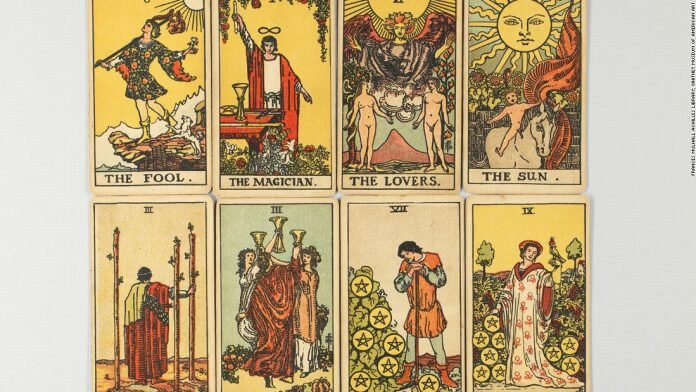
Keep the question in mind, shuffle, choose your cards and look to your future. For centuries, people from all walks of life have turned to the Tarot to anticipate what may lie ahead and achieve a higher level of self-awareness.
The mysterious symbols of the cards became culturally rooted in music, art and cinema, but the woman who wrote and drew illustrations of the most widely used set of cards today – the Ryder-Waite deck since 1909, originally published by Rider & Co. – vanished, overshadowed by the man who ordered it, Arthur Edward Waite.
Now, more than 70 years after her death, creator Pamela Coleman Smith has been included in a new exhibition at the Whitney Museum of American Art in New York City, which highlights many invaluable early 20th-century American modernist artists in addition to famous names such as Georgia O. “Keefe and Louise Nevelson.
Eight maps from an ancient set of Ryder-Waite-Smith decks printed between 1920 and 1930. Credit: Francis Malhol Achilles Library; Whitney Museum of American Art
Smith, like many other women artists of the era, fell victim to the “marginalization of women’s accomplishments,” according to Barbara Haskell, the show’s curator.
Whitney’s exhibition features a vintage set of Tarot Smith cards, as well as one of her dreamy works of watercolor and ink from 1903 called “Wave”, which is now part of the museum’s permanent collection.
Smith was a fascinating but mysterious figure, a mystic who was part of the Hermetic Order of the Golden Dawn, a secret occult society that borrowed ideas from Kabbalah and Freemasonry for its own system of spiritual beliefs focused on magic and metaphysics. Born in London to American parents, Smith spent her childhood in Jamaica and fashioned herself in the West Indies, leading to conflicting reports as to whether she was bisexual. She was also chosen as a cult queer icon because she lived for many years in a house with a female companion and business partner named Nora Lake – although Haskell says it is “unclear” whether their relationship was romantic.

Pamela Coleman Smith illustrated the most famous Tarot deck, but her contribution was overshadowed by A. E. Waite, who commissioned her. Credit: Public property
In Smith’s work, “she was drawn to a kind of mystical vision of the world,” Haskell said in a telephone interview. She listened to music to unlock her subconscious, and reportedly had synesthesia, a neurological condition that causes a person to see shapes or colors when they hear sounds. Smith worked in a symbolist tradition – which prioritized metaphorical and emotional images over everyday ones – at a time when mass industrial and social change was taking place in the United States immediately after the early 20th century.
“Her fine arts really represent a time when people find solace in more spiritual concerns, especially at a time when industry seems to be taking over, creating a sense of fragmentation and isolation,” Haskel explained.
“Completely her”
When Waite approached Smith to illustrate her vision of the converted Tarot deck, she was 31 years old, and she exhibited her paintings in the New York Gallery by renowned photographer Alfred Stiglitz, who was an important admirer of her work. Waite, like Smith, was a member of the Hermetic Order, but rose to the level of Grand Master. He studied ancient texts extensively and created new ones on the subject of mysticism, and had ideas about the concept of new cards and how to arrange them.

“Star” from the Great Arcana. Some of Smith’s original tarot works were in the collection of the Alfred Stiglitz / Georgia O’Keefe Archive, which is now part of the Yale Library. Credit: Provided by Yale University Library
Tarot exists from Italy in the early 15th century, separated from traditional playing cards. The 78 cards are divided into two groups called the Senior and Minor Arcana. The Elder Arcana presents allegorical characters such as the moon, sun, fool and lovers, while the Small Arcana are divided into number and face cards of four colors: sticks, swords, cups and pentacles. While the previous decks were less pictorial in nature, Smith is filled with magnificent images, making them easier for the reader to interpret.
“He was the one who incited the deck, there is no doubt about that,” Haskel said. “And he probably had a pretty big contribution to the Old Arcana.”
Although Waite may have guided the concepts of these 22 maps, all the images were Smith’s own. And because Waite was less interested in Small Arcana, which consists of 56 cards and was often more simplistic graphics like playing cards, these ideas were “completely hers,” according to Haskell. Smith performed 78 drawings from his Chelsea studio in London using ink and watercolor.

Two swords. Smith came up with 56 Little Arcana maps on his own. Credit: Provided by Yale University Library
Smith’s influence on the images included indulgent ink illustrations by English artist Aubrey Beardsley, vivid Pre-Raphaelite paintings, rich color blocking of traditional Japanese engravings and Art Nouveau details, according to Haskell.
His career was cut short
Only three years after the publication of the Ryder-Waite deck, Smith stopped doing art, which was not a lucrative prospect for her. She organized her last art exhibition, converted to Catholicism and bought a house in Cornwall after inheriting money from the death of a family member. She and her partner Lake moved into the house and earned a living by renting it out to priests. Smith also participated in the women’s suffrage movement as well as in the Red Cross, her priorities seeming to have changed.
“Because she stopped working … she stopped being present in the art world,” Haskel said.
When the Great Depression hit in 1929, devastating economic consequences closed galleries and pushed American art from the decadent Art Nouveau style to the “sustainability of everyday life,” Haskel said. These seismic shifts probably attributed Smith’s short career to the footnote of art history.

Smith was the first non-photographic artist to be exhibited in Gallery 291 of Alfred Stiglitz. Credit: Alfred Stiglitz / Georgia O’Keefe Archive; Yale Collection of American Literature
“Most of the artists who worked either turned to more realistic styles or fell into obscurity,” she explained. Many of them “did not have a stable gallery representation.”
Despite the growing interest in recent years, Smith is not collected or exhibited widely today, but Haskell believes that all her works deserve revision, and that Smith was a symbol of the period to which she belonged.
“She imagined all this mood at the turn of the century, which had to go deep into the unconscious and take advantage of intuitive experiences,” she said. “Not to get involved in concrete, rational facts, but to really explore these more emotional areas.”
Top image: “Wave”, author Pamela Coleman Smith (1903).
Source