


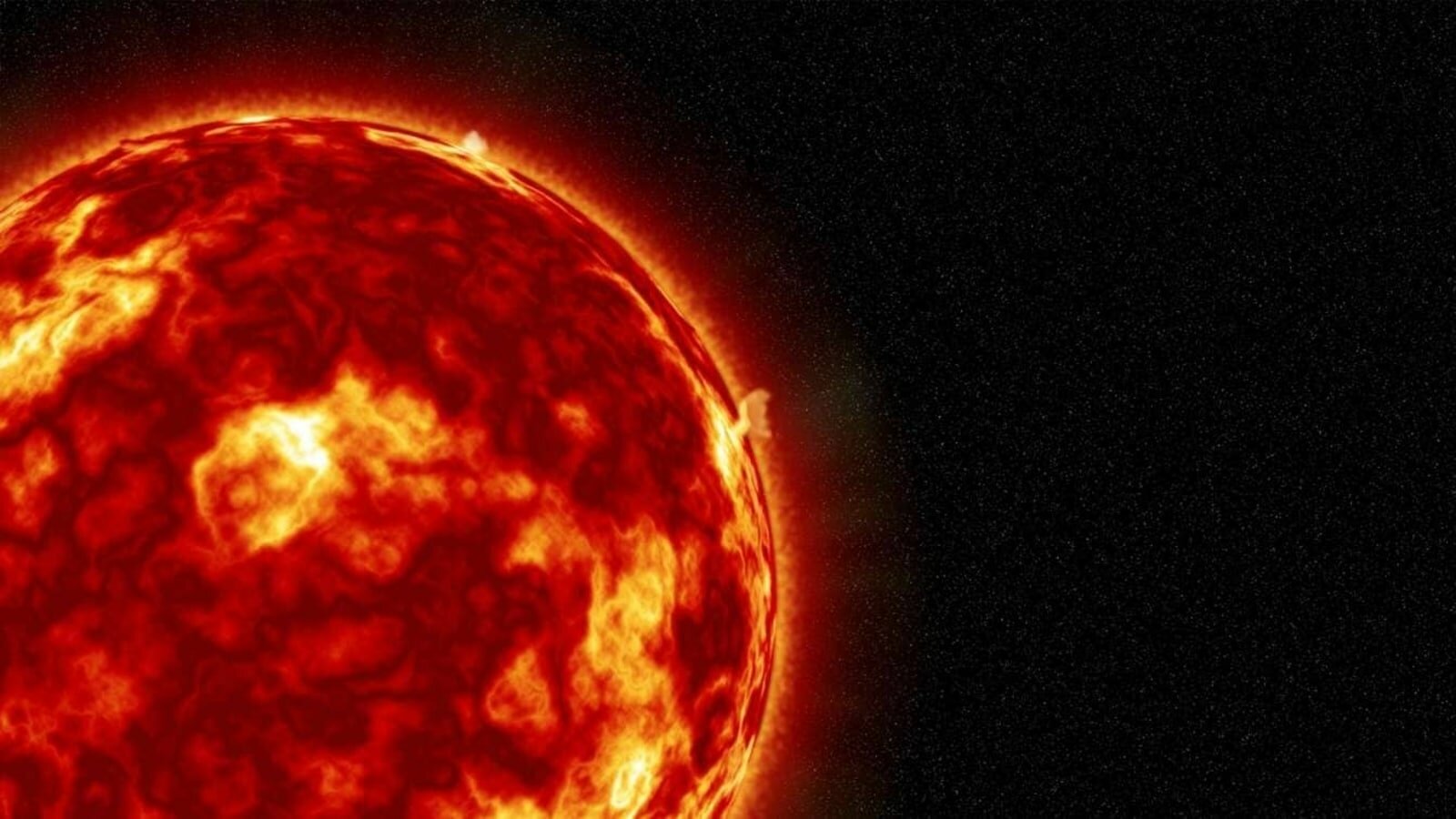
NOAA has predicted that there is a 60 percent chance of Class M solar flares today due to a giant sunspot facing Earth.
A giant sunspot detected on the sun’s surface has sparked fears of a strong solar flare that could hit Earth. NOAA forecasters warned there is a 60 percent chance of an M-class flare and a 15 percent chance of an X-class flare. It should be noted that a class X solar flare is one of the most intense solar flares. Basically, solar flares are classified into four classes – A, B, C, M and X, based on their intensity. Solar flares are intense bursts of radiation from the release of magnetic energy from a sunspot.
The SpaceWeather.com report suggested that the main source of these strong solar flares is a giant sunspot AR3190. The worrying thing is that this sunspot is facing Earth, which increases the chance of a direct impact on our planet. Not only that, it is one of the largest sunspots of the current Solar Cycle 25, which is at its peak. “It’s almost five times the diameter of the Earth and could be seen through the thick, moist atmosphere over the Gulf of Mexico,” David J Kriegler, one of the observers, told Spaceweather.com.
The sunspot’s sheer size makes it an easy catch for amateur astronomers. You don’t need a solar telescope to witness this massive sunspot AR3190. Eclipse glasses work best here. However, you must be careful! “Even when the sun is dimmed by low clouds or haze, looking directly through the camera can damage your eyes. Always use the LCD screen for image search,” the SpaceWeather.com report said.
Tech behind solar flare detection
From NASA’s Solar Dynamics Observatory (SDO) to the National Oceanic and Atmospheric Administration (NOAA), many agencies are constantly tracking these solar flares. Then there’s the DSCOVR satellite, which tracks various measurements of the sun and its atmosphere, including temperature, velocity, density, degree of orientation and frequency of the solar particles. The recovered data is then passed through the Space Weather Prediction Center and the final analysis is prepared.
Source link
