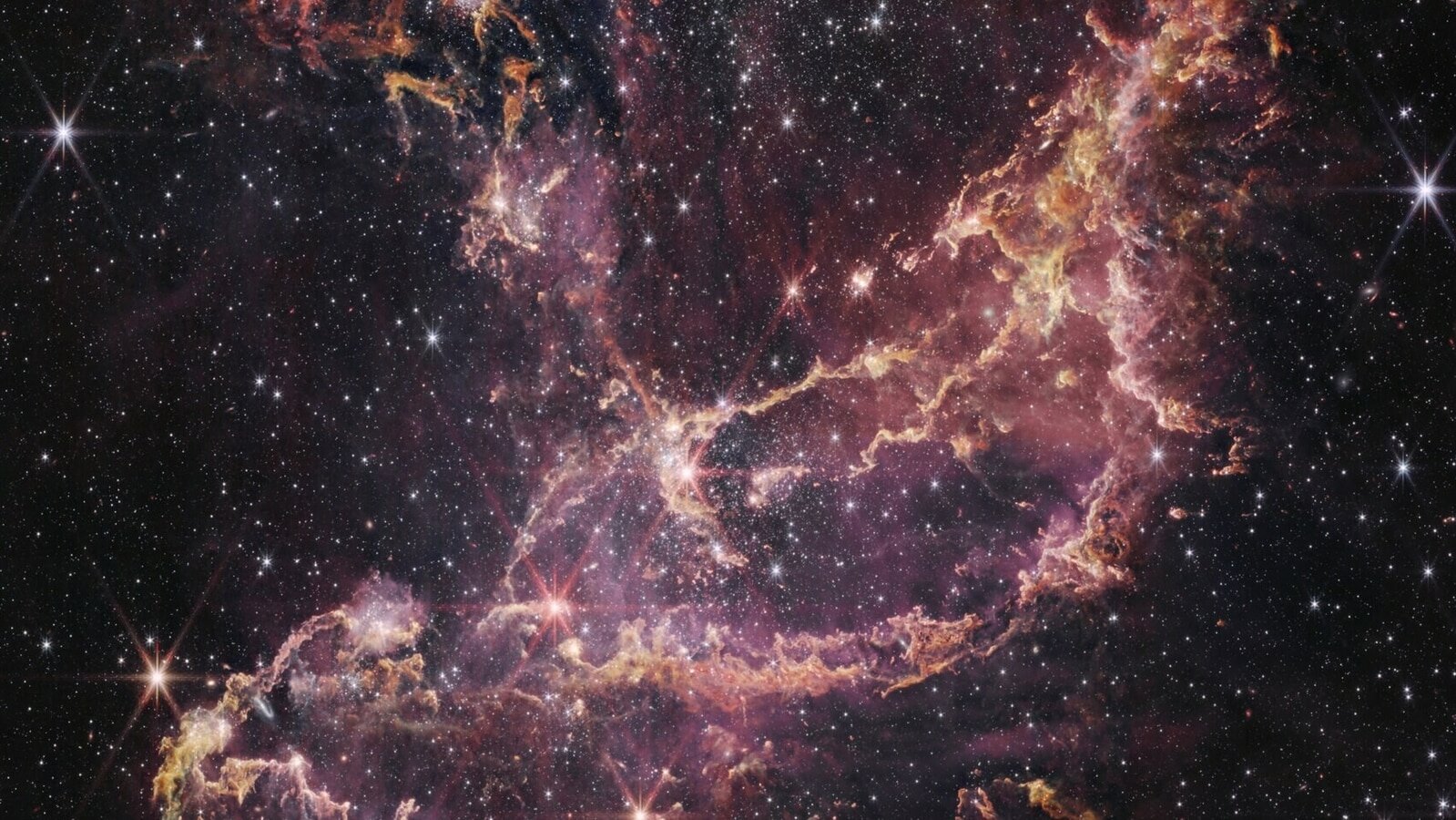
The new findings from the James Webb Space Telescope are all about solving the mysteries of NGC346, one of the most dynamic star-forming regions near our Milky Way galaxy, says ESA.
The universe is full of mysteries. Some are horrific and some are great. To find out what is happening in space, NASA and ESA have deployed a number of telescopes and the latest is the James Webb Space Telescope. His greatest task is to look back in time to learn more about the origin of our universe.
The new findings from the James Webb Space Telescope are all about solving the mysteries of NGC346, one of the most dynamic star-forming regions in nearby galaxies. However, Webb’s new findings have made NGC346 a little less mysterious.
NCG 346 is located in the Small Magellanic Cloud (SMC), a dwarf galaxy close to our Milky Way galaxy. The SMC contains lower concentrations of elements heavier than hydrogen or helium, which astronomers call metals, than in the Milky Way.
“A galaxy at cosmic noon would not have one NGC 346 like the Small Magellanic Cloud; it would have thousands,” said Margaret Meixner, an astronomer with the Universities Space Research Association and principal investigator on the research team. “But even if NGC 346 is now the only truly massive cluster furiously forming stars in its galaxy, it gives us a great opportunity to explore the conditions that existed on cosmic noon.”
By observing protostars still in the process of forming, researchers can learn whether the star-forming process in the SMC differs from what we observe in our own Milky Way. Previous infrared studies of NGC 346 have focused on protostars more massive than about five to eight times the mass of our sun.
“With Webb we can probe for lighter protostars, as small as a tenth of our sun, to see if their formation process is affected by the lower metal content,” says Olivia Jones of the United Kingdom Astronomy Technology Centre, at the Royal Observatory Edinburgh, a co-investigator of the program.
The research team also has spectroscopic observations from Webb’s NIRSpec instrument that they continue to analyze. This data is expected to provide new insights into the material accreting on individual protostars, as well as the environment directly surrounding the protostars.
Source link